
In this guide
The decisions and working steps ahead.
Read the two receipts
Replay three deliveries
What to take into a checkout review
Two Solana receipts arrived at the same token account three seconds apart. Each transferred 0.001 devnet USDC. A reconciliation rule that looked only at the recipient and amount would have treated them alike. Their memos were different. We used that difference to test which receipt should close an invoice and what happens when its notification arrives twice.
The transfers are public devnet records. We created invoice DEMO-001 locally for this exercise and associated it with the first memo after observing the transactions. The invoice, delivery sequence and ledger outcomes belong to the replay. The senders’ original purposes are unknown. Download the two receipts and SQLite replay
Read the two receipts
Receipt A landed at 01:23:02 UTC on November 29, 2026, in slot 527421005. Its memo was 30a484e1ea43520a23cff940cc6fe7d0. Receipt B landed at 01:23:05 UTC in slot 527421019, with memo 65a476602c90412627d6f77dff9cdb38. Each Explorer link opens the devnet record and shows the full signature. Receipt A · Receipt B
We fetched both signatures with getTransaction, finalized commitment and jsonParsed encoding. Each succeeded and contained one top-level SPL Token transferChecked instruction and one memo. We verified the destination token account, the token program and Circle’s devnet mint. Each destination balance rose by exactly 1,000 base units. USDC has six decimal places on this mint, so that is 0.001 USDC per transfer. Solana RPC method · Circle’s network-specific USDC addresses
Replay three deliveries
The example invoice expects 1,000 base units at the observed destination and mint. It recognizes only receipt A’s memo. Download the SQL file and run it against an empty, in-memory SQLite database.
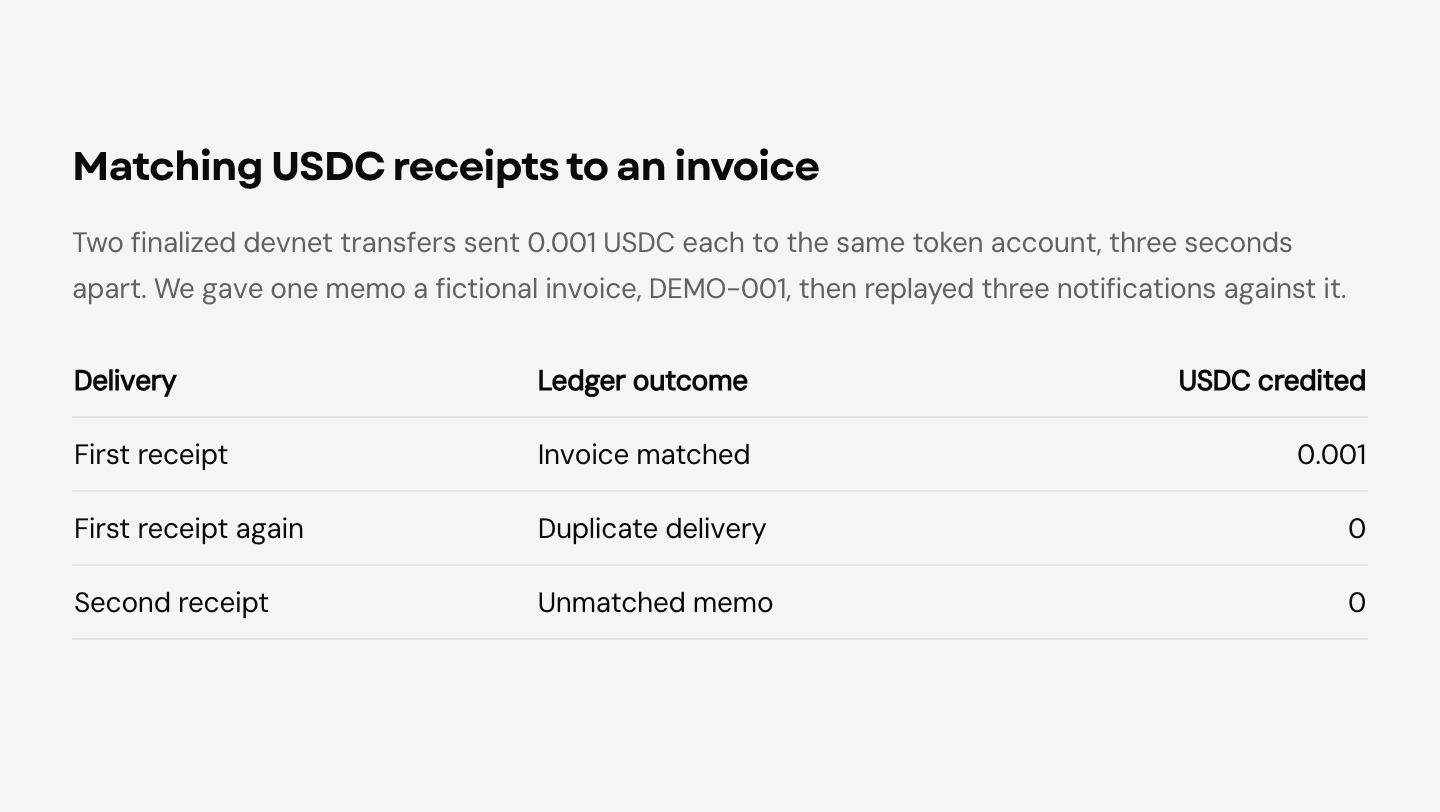
sqlite3 -header -column :memory: < solana-usdc-reconciliation.sql- Receipt A matched DEMO-001. We expected one credit. The replay recorded 1,000 units and stored A’s signature on the invoice.
- Receipt A arrived again. We expected the existing credit to stand. The journal recorded a duplicate delivery and zero additional units.
- Receipt B had no matching invoice. We expected the new signature to remain visible for review. The journal recorded an unmatched memo and zero credited units.
Finance can now account for both transfers. Of the 2,000 units received, 1,000 settled DEMO-001 and 1,000 remain unallocated. The review row is receipt B, slot 527421019. Keep its full signature and memo when asking the operator to look up the intended invoice. The repeat of A needs no second credit.
What to take into a checkout review
In a checkout, create the order reference before issuing payment instructions. Verify the actual transfer’s finality, mint, destination and raw amount before crediting that order. A public memo helps identify an invoice. Anyone can copy it, so it cannot authenticate the person presenting a signature. Solana payment verification
This replay uses one transfer per signature, one local writer and a fixed set of deliveries. For a batch transaction, identify the individual transfer instruction. For concurrent workers, enforce a unique credit in durable storage and commit the credit and invoice update together. A useful vendor acceptance test is to deliver the same event to two workers and inspect the resulting journal. Transaction reliability guide
Use Explorer for the devnet receipts above. The Builderz inspector accepts mainnet signatures and includes a summary of this replay. For the scope of a commissioned integration, see the stablecoin payments package. B-Pay is a separate historical example of team invoicing. Transaction inspector and replay · Stablecoin payments package · B-Pay project